A Deep Southern Throwback Thursday: Mary Crovatt Hambidge, 1973
Though her name may not be familiar to many, Mary Crovatt Hambidge was an important Southern artist. This week marks the fiftieth anniversary of her death on August 29, 1973. Her legacy continues at The Hambidge Center in northeastern Georgia.
Born in 1885 in coastal Brunswick, Georgia, Mary Crovatt went to school in Cambridge, Massachusetts before moving to New York City, where she met artist Jay Hambidge. During a visit to Greece with him in 1919, she was fascinated by weavers doing their work near the Acropolis, and later became involved with the textile artists in Rabun County, Georgia where she moved in the late 1920s. Jay, who was eighteen years her senior, had died in 1924. According to the Hambidge Center’s History page, “While no marriage certificate has been discovered, they considered themselves married and referred to themselves as such in numerous documents. Until 1938, common law marriage was legal in New York, and Mary was the beneficiary and executor of Jay’s estate.” It was there in Georgia where she began the work for which she is now known.
The one time I went to the Hambidge Center, I was on a residency at the nearby Lillian E. Smith Center and the artist in the adjacent cabin suggested that I ride up there with her. We mostly looked at the place from the car, but I was lucky enough to be there when the grist mill operator was working. He was tired and sweaty but still kind and gracious about my request to buy some meal from him.
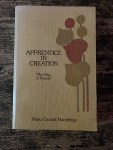 Another of my encounters with Hambidge’s works involves the book Apprenticeship in Creation: The Way Is Beauty, which was printed by the Hambidge Center in 1975. This whimsical and somewhat odd collection contains mostly short essays and even shorter ruminations. Though it spans more than 300 pages, many of those pages only contain a sentence or two. Overall, her writing gives the reader a sense of a very broad worldview, which leans toward a Unitarian-Universalist kind of spirituality combined with distinctly anti-commercial politics. It’s a good book to flip through and engage in small bites, though a straight read-through might be difficult.
For those interested in knowing more about Mary Crovatt Hambidge, the thirty-minute documentary Mary Crovatt Hambidge: Whistler, Wanderer, Weaver, Utopian can be viewed on Vimeo.
