
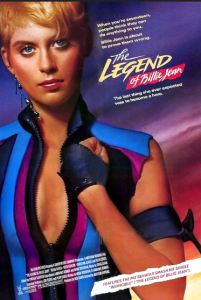
Southern Movie 73: “The Legend of Billie Jean” (1985)
The Southern Movies series explores images of the South in modern films as well as how those images affect American perspectives on the region.
Set on the Gulf Coast of Texas in Corpus Christi, 1985’s The Legend of Billie Jean was optimal Generation X and very Southern. The story centers on a small group of teenagers who go on the run from the police after one among them shoots a local store owner with his own gun. Billie Jean Davy, for whom the film is titled, and her younger brother Binx have been struggling against the bully Hubie Pyatt, who has damaged Binx’s scooter as well as his face. But when Billie Jean goes to Hubie’s father to get money for scooter repairs, the man has an arrangement in mind that would have her giving him sexual favors in return for small, incremental payments. When Binx walks in on the elder Pyatt trying to force her into compliance, he has the gun that he found in one of Pyatt’s drawers. Directed by Matthew Robbins and starring Helen Slater and Christian Slater, The Legend of Billie Jean offers story that is one part crime drama and one part generational struggle, playing out on Southern beaches during a summer in the mid-1980s.
The Legend of Billie Jean opens with a small scooter in a garage, and we see a young teenage boy rolling it out. He’s wearing shorts and a denim vest. A radio DJ’s show is playing over the scene as the boy goes into the yard of the South Texas trailer park to pick up a young woman who is getting dressed in the yard. She pulls off her shirt behind a wooden fence and puts on a floral print dress. We understand that they are a younger brother Binx (Christian Slater) and older sister Billie Jean (Helen Slater) as they hit the two-lane highway on the scooter. Soon, though, they pass a gas station and catch the attention of a carload full of young men in a convertible muscle car. They jump in and begin to chase the scooter, catching up easily. On the highway, where the waterway runs alongside, the teenage boys taunt the pair. Arriving at a roadside drive-in, they get out of the car, and their ringleader Hubie makes sexual overtures at Billie Jean. Yet, Binx halts the advances by pouring a milkshake on his head and pulling away.
The riders soon come to a swampy little swimming hole, where they strip down to their bathing suits and take a dip. Billie Jean is in a bikini bottom and cutoff tank top (which is now an iconic image from the film.) The little brother Binx warns his sister to check the water for alligators before diving, and she laughs him off. Then the water swirls and thrashes before going quiet, and Binx jumps in to save his sister . . . who comes up laughing at him. After their laugh, Binx and Billie Jean lie on floating platform in the sun, and Binx asks to hear about Vermont, again. They wonder at a life without severe heat. As they’re luxuriating, the real threat arrives. The carload of boys has found them. Hubie gets out and begins to manhandle the scooter. The brother and sister swim across the lake to stop him, but Hubie easily throws Binx on the ground and drives away on the scooter, covering Binx with dirt. Billie Jean tells him not worry about it, that they will get the scooter back.
That evening, in the trailer, their mother is half-scolding them for the bad situation while she gets ready for a date. In typical GenX fashion, she blames her son for the conflict and seems unwilling to intervene. She soon leaves for her date, and after being prompted with false hope by the horn of a passing golf cart, Binx runs off down the road to retrieve his scooter. This leads Billie Jean to have two friends, Ophelia and Putter, to drive her to the police station, where she wants to file a report. She explains that Binx bought it with insurance money that their dead father left them. Once again she is dismissed, as the detective she speaks to (Peter Coyote) says that Hubie is probably just trying to get her attention. Yet, when they arrive home, there is the scooter – all smashed and ripped up – and Binx is inside in the dark. Hubie has beaten him up badly.
In the light of day, Billie Jean and Binx have Ophelia to take them in the trailer park’s station wagon to the Pyatt’s seaside gift shop. Ophelia drives like a fool, and they’ve left the immature Putter at home. Binx is ordered to stay in the back seat, while Billie Jean goes inside. She finds Hubie working among the shelves and hands him a bill for $608 to fix the scooter. He scoffs at the bill, so she feigns a flirt with him and knees him in the balls. As Hubie is lying on the floor, Mr. Pyatt strolls in, calling for his son, then joins the dispute when Hubie shouts that Billie Jean is lying. She lives in the trailer park, Hubie remarks. What difference does that make, Billie Jean retorts. Mr. Pyatt appears to be more tactful than his son, but is also shadier. The elder man saunters around in bootcut jeans and untucked shirt with a bolo tie. He mumbles to Hubie to go outside, he’ll handle this himself. At first he appears to side with the pretty teenage girl, then says that he doesn’t keep large amounts of money in the register. She must come upstairs to the office to get it. A suggestion she at first resists, but he says, “You want the money, dontcha?”
Upstairs, Mr. Pyatt changes his mind about being so generous. He goes to a cash box and gets a tall stack of bills, but then refers first to her mother being pretty, then to the daughter being even prettier. His low voice and his insinuations tell us where the scene will go. He lays out five $10 bills and informs Billie Jean that she’ll get that much today and a little more every time she comes back, as he caresses her wrist then grips. She fights back, but the older larger man subdues her and utters the movie’s now famous lines: “You pay as you go, and earn as you learn.” As she is struggling against him, though, Binx and Ophelia come into the store. Binx doesn’t see his sister anywhere, so he goes to the cash register and pounds on the keys. The drawer opens, and there isn’t much money . . . but there is a .38 snub nose revolver. (Binx is so naive that he is looking at the gun and pointing the barrel right at his own face.) Meanwhile, Billie Jean knocks Mr. Pyatt off of her and descends the small spiral case to re-enter the store, where Binx has the gun. The boy thinks he’ll take control of the situation and points it at Pyatt, who tries to talk his way clear. Then Hubie returns, completely unaware of what he is walking into. The father tells his son to call the police, that Billie Jean has “suckered” him upstairs so Binx and Ophelia could rob the store. Binx tries to maintain control, refusing to let Hubie near the phone. As a last ditch effort, Pyatt throws Billie Jean aside and moves toward Binx, telling him the gun isn’t loaded. The boy is so inexperienced with a gun that he doesn’t even think to look in the chambers. Yet, as he examines the pistol, he pulls the trigger and shoots Mr. Pyatt in the chest. Ophelia screams, everybody runs, and Hubie grabs the telephone.
The next few minutes show scenes of panicked teenagers grabbing their things from the trailer to run away. Ophelia sits in the Breeze Haven Trailer Park station wagon alone while Billie Jean and Binx grab clothes and a little money. Putter, who is grounded from the night before, asks Billie Jean if she can some with them, gets told no, then lies to Ophelia saying she was told yes. Under cover of dark, their place of refuge is an abandoned mini-golf park. They try to get Putter to go back home with Ophelia but she’ll have none of it.
Back at the Pyatts’ store, the detective from the night before, Ringwald (Peter Coyote), arrives. He is shown school yearbook pictures of Binx and Billie Jeans, then mutters that he blew it. Seeing Hubie nearby, the detective goes over and makes nice before mentioning scooters to the usually feisty boy. We know that the Pyatts’ narrative is not going to hold up.
Over the next few scenes, we see the four teenagers driving around Corpus Christi and understanding what their predicament is. In a gas station, Billie Jean gets recognized by two teenagers, and they buy a newspaper, which tells them that Mr. Pyatt is not dead. Good news for them. But callers to the local radio station are against them, making Texas-style comments that justice must be done. Billie Jean calls home, where the police are waiting in anticipation of a call, and she speaks with Ringwald. They will turn themselves in, she says, but they want the $608 from Pyatt. He has to hand it to them, in person, in public. They will meet Pyatt and the cops at Ocean Park Mall near the fountain.
Across town, the Pyatts’ store is surrounded by curious onlookers, some of whom want to buy the homemade Wanted poster they have made with a picture of Billie Jean barely dressed and emerging from the swampy pond. Ringwald is there questioning Pyatt about whether he’ll accept the arrangement. He says hell no and also stands defiant when Ringwald comments on his willingness to sell Billie Jean’s image on a poster. (For a guy who got shot the day before and who proclaimed out loud that he lost two pints of blood, he looks pretty good, walking around with his arm in a sling but otherwise looking like nothing happened.)
At the mall, Billie Jean and her friends have a plan that is so GenX. After stealing their equipment – walkie talkies and such – from a mall toy store, Billie Jean gets ready to meet Mr. Pyatt while the other three wait in the parking deck. While Ringwald and Pyatt wait for Billie Jean, the two men converse and we find out that obstinate Pyatt is letting Ringwald put up his own money for the scooter repair. Then Billie Jean appears, looking very GenX in her baggy coveralls and man’s fedora, coming down the escalator. Ringwald caps off his conversation with an insinuation that he knows what Pyatt was doing with a pretty young girl up in his office. The unflappable Pyatt admits nothing and waits on his prey. Commenting to Billie Jean that she made a mistake, he drops the envelope of cash – that isn’t even his – and calls Hubie out of the potted plants. The incompetent boy chases Billie Jean but once again gets kneed in the crotch. His buddies emerge to help too, but they are equally incapable. Because these guys have messed everything up, the cops can’t catch her either. She runs through the mall with an overdub of Billie Idol’s “Rebel Yell.” The getaway car is all lined up, and Billie Jean escapes when Binx pushes a dumpster in front of the door she comes from. But the crafty Ringwald took another route and comes out a different door. Binx, who has clearly learned nothing, pulls a toy pistol and holds off the detective. To Binx, it’s all game. The battered old station wagon goes blasting through the barrier at the parking deck entrance, and they’re on the run again!
After seeing themselves on the news and having only seventy-eight cents for dinner, the foursome are realizing their predicament. They’re just kids. They don’t want to be committing crimes or running from the law. But they can’t go home. So they decide to find a big, fancy house to break into. After finding one that they believe is empty, they raid the kitchen and set up a smorgasbord in the dark dining room. Billie Jean goes to walk around the house and finds one of its occupants: a strange young guy who is wearing a halloween mask. His upstairs bedroom is something like a creepy media studio, but he isn’t threatening. When the others come upstairs and find him too, Binx wants to pull the outlaw act but the guy – Lloyd – just turns on the TV so they can see themselves on the news. There is Pyatt, excusing his behavior at the mall, while denigrating the younger generation, then the camera switches to a truck stop clerk who claims that the gang robbed him at gunpoint while doped up on drugs and alcohol. Disconsolate, they flip the channel from the absurdity and lies then land on the old black-and-white film that had Jean Seberg playing Joan of Arc. None of the trailer park kids know her story, so Lloyd gives them a quick lesson before jumping out his window into the swimming pool below. They all follow— except Billie Jean, who stays and finishes the movie.
 After their swim, Billie comes running outside with an idea. Can Lloyd make video tapes? Sure. And copies? Sure. Billie Jean is going to send a taped message in response to all of the people being interviewed on the news. And there’s one more surprise. When she emerges from the bathroom, she has cut off all of her hair, like Joan of Arc. After they make the video tape and are about to leave, Lloyd offers himself as a “hostage” . . . willingly. They take him up on his offer, not knowing exactly what they’re saying yes to.
Once the tape is broadcast, we see its contents. Billie Jean sends a message to the public that they aren’t liars or thieves, and that Mr. Pyatt must pay. “Fair is fair,” she declares. Back at the police station, where Ringwald and the others are watching, more info comes in: they have a hostage. Lloyd is the district attorney’s son. (We know that at this point, but Billie Jean and the others don’t.) As the DA and Ringwald talk at the DA’s house, they start to figure out that this is one part manhunt and one part search for a group of kids on a joyride.
Returning to the Pyatts’ store, they’re wrapped up with merchandising their newfound fame. They have t-shirts, posters, all the things. Even a large effigy of Billie Jean. Ringwald and the DA arrive to talk to Pyatt who is his same asshole self. Ringwald doesn’t think it’s a kidnapping, but the DA assumes that it could be. Pyatt just wants the “filth” cleaned up and shows the two law men letters of support that he has received from all over the country. It still looks like Mr. Pyatt is winning.
Across town, a few little kids identify the station wagon and approach, asking if she’s Billie Jean. The loudmouthed Putter confirms, and they say, “You gotta help Kenny, he’s in trouble.” Next we see, Ophelia, Binx, and Lloyd leave a clothing store – where they’re buying disguises – while Billie Jean is striding through a neighborhood with a small army of children. The first couple of kids have taken her to a house where a drunk and abusive dad has his son in a corner, frightened and alone. Billie Jean enters the house and tries to bring the boy out, but his father confronts her at first. Then he looks at the window, seeing all of the young people, and changes his tone. She walks the boy out and announces that he’ll be spending some time with his grandma, which raises cheers among the crowd. They stop then to sign autographs and have pictures taken. Billie Jean is clearly uneasy, though the others enjoy the attention. Binx tells a few lies when asked about incidents they’ve been accused of, and Billie Jean corrects him. Then, as a truck passes by, a woman recognizes them, and her redneck boyfriend decides to shoot at the car. He wants the reward money, but they speed away and escape again, but with a flat tire.
We’re at the one-hour point, in a ninety-minute movie. Our anti-heroes are exhausted and are running out of places to go. They’ve been on the news and are easily recognizable. Now we know about the fervent law-and-order sentiment against them. Earlier in the film, we heard people on the radio saying they had to be stopped, Mr. Pyatt has ratcheted up his rhetoric, and now a good ol’ boy in a monster truck is shooting at them in traffic in broad daylight. We’ve got a generational struggle going on: the young people love her, and while the adults want her stopped at all costs.
The gang of four stops by the waterside for a rest after their hair-raising experience with the rifle-toting good ol’ boy. They have to change the tire, and while they do, Billie Jean gives Putter an outdoor bath, since the young girl had her first period during the ordeal. As they hang around and figure out what to do, Lloyd and Billie Jean chat, and their romantic connection becomes clear. But Billie Jean is all business. She wants to get Ophelia and Putter out of the situation and plans to sneak away and alert the cops to where the car is.
Soon the cops, including Ringwald, arrive to find Ophelia and Putter asleep in the station wagon. Ringwald gives them the tough-cop treatment and tells them that Billie Jean has ratted them out. He wants to know where she is. Ophelia responds, Everywhere!
Debating on how to flee and where, Binx, Billie Jean, and Lloyd can’t agree on what to do or how. Lloyd offers to foot the bill for them to go to Vermont, but Billie Jean retorts that he’s just running away from home and is not in the predicament as her and her brother. While they fuss, Binx tries to steal a convertible Cadillac but nearly gets caught, which splits the three up. We follow Billie Jean for a while as a network of teenagers – many of them girls who have taken on her look – pass her from car to car, keeping her moving and undetectable. Cops search the streets as they do this, and we find out how popular the unwitting anti-hero has gotten.
After the montage, Billie Jean finds Binx and Lloyd at the abandoned mini-golf place. Billie Jean leaves Binx behind pretty quickly and snuggles up with Lloyd in one of the little shelters among the course. They have some quiet words under their sleeping bags and smooch a little bit. We are supposed to understand that they spend the night together, but we’re spared the visuals.
In the morning, Ringwald and the other cops are going through the station wagon andfind the colored golf balls from the mini-golf place where they’re hiding. He goes out there alone and talks into the empty space, believing them to be listening. He tells them that a scooter has been donated and that they can get what they want, if they’ll end this situation. They are, in fact, hearing what he says, and Billie Jean calls the police station later from a pay phone to dictate her terms.
This arrangement creates the final scenes in the movie, which occur on the beach. Loads of people are there, most of them young, and the police try to hold them back. The authority figures – Ringwald and the DA – half-bicker over how the thing should be handled. Ringwald has compassion for the kids, but the DA has to assume that his son is in danger. Soon, a team of snipers arrive, and Ringwald raises hell about that. But he doesn’t have time to get into it. Billie Jean and Lloyd come over the hill, with Lloyd’s hands on his head and his captor holding a pistol. Only it’s not really Billie Jean— it’s Binx in a dress. When we see the real Billie Jean, she’s in the crowd and is disguised in a wig, allowing her to uncover the scooter for Binx to see. Then that damn Hubie Pyatt, always the antagonist, bursts through the police line and runs out screaming, It’s not Billie Jean, it’s her brother! Frustrated by this unforeseen problem, Binx points the toy pistol at Hubie, and a sniper shoots him in the shoulder. Everyone goes nuts! Binx is taken away in an ambulance, which Billie Jean chases but doesn’t catch. Yet, it’s not over . . .
Now, she comes across Mr. Pyatt and his outdoor t-shirt stand full of posters that includes full-color images of her in a bikini and pictures of her face in a target. The final confrontation goes down, and she reveals his antics in the upstairs office to the watching crowd, which soon includes Ringwald, the DA, and Lloyd. Everyone stands stone-faced while she elaborates on the not-so-secrets they share, while Pyatt denies everything. Even Hubie is disgusted and sneaks away. Ultimately, Mr. Pyatt tries to give her a big ol’ wad of cash and says, “For your trouble.” But Billie Jean just gets more indignant, throws the money at the man, and knees him in the balls, too. He falls down in the process and knocks over one of his little torches on the scene. Soon, the whole place goes up, and the effigy of Billie Jean falls while she watches. We know as the flames destroy his merchandise that Mr. Pyatt will always be a lying, greedy asshole. Turning to run away, she runs into Ringwald, who just smirks and lets her go. The movie ends with the brother and sister in the cold snows of Vermont, where Binx is eyeing a snowmobile . . .

The Legend of Billie Jean wouldn’t be the same movie if it were set in another part of the country. We’ve got guns, we’ve got social class issues, and we’ve got law and order. The general plot and several of its main events involve guns, their use, and their misuse. If Binx had never grabbed the gun out of the cash register, the whole thing would not have happened. Several of the mishaps occur because Binx is a boy who knows nothing about guns but tries to play games like he does. Later, to emphasize the point, there’s the redneck in the monster truck who believes that he can pull out a deer rifle in broad daylight and shoot into a moving car full of teenagers. Why does he believe that’s OK? Because that’s what justice looks like to a lot of Southerners. It’s what justice looked to like to Binx in the Pyatts’ store, and it’s what it looked like to the monster truck dude.
The film also deals in a very Southern way with issues of social class, of who can be believed and who can’t. The Pyatts are business owners in the community, while Binx and Billie Jean are trailer-park kids living with a single mother. The only way that Binx got a scooter was through the death of his father, while Hubie and his friends are riding around in a convertible muscle car. In the store, when confronted about his own criminal behavior, including destruction of property and assault, his defense is to claim that the trailer-park girl is lying. We then see where Hubie gets it. His father takes the trailer-park girl upstairs with the intention of something between coerced prostitution and sexual assault. He assumes that she will concede to giving sex for money because of who she is and where she lives. After he refuses to pay for the scooter that his son damaged, his assumption throughout the film is that he will be believed while Billie Jean will not be.
Furthermore, understanding it in context of the zeitgeist in the 1980s, its story shows the younger generation railing against the older generation’s “law and order” mentality. This pervading idea in post-Civil Rights Southern culture said that the social-equality movements of the 1960s and ’70s had resulted in a chaotic, “all hell broke loose” environment where people of color were out of control, women were out of control, children were out of control . . . and white men had to get them back under control, in the name of “law and order.” The Legend of Billie Jean deals with the latter two of those three groups I just listed. We’ve got a single mom who can’t control her children, and a single father who can’t control his son— results of the breakdown of the traditional family, i.e. James Dobson. We’ve got a pretty girl who defies an older man’s advances – women are supposed to yield to men, in this way of thinking – and she goes on the run, cuts off all of her hair to look like a boy, and ultimately burns down his business. During this whole thing, Mr. Pyatt is saying to anyone who’ll listen that no concessions should be made, the kids need to be subdued, and his word should be believed over theirs. The truth is that he is an abuser, a liar, and a profiteer who has no shame, but that has no bearing in his sense of who should be regarded more highly. (Thankfully, the police – all men – see through him, even though they still have to do their jobs.)
While the movie is politically progressive in terms of gender and age, it is virtually mute, even sanitized, in its handling of race. Almost everyone we see in the film is white, even though Corpus Christi has a significant Hispanic/Latino population. We do see a few black people, here and there, but they are extras in crowd scenes. This is a very white movie, even though its locale is less so. Certainly, the story and the medium wouldn’t lend itself to taking on racial issues as well, but it can’t be ignored that this one is whitewashed. The closest we get to a racial aspect in the film is Mr. Pyatt’s sense of white male privilege, which is seen but never discussed.
One other “character error” in the movie, pointed out in IMDb’s “Goofs” section, reads, “The majority of characters are depicted to have heavy southern accents. However, in the South Texas region where Corpus Christi is located, not many residents have an accent.” The blog Film School Rejects also comments on the perhaps-too-heavy Southern accents, as does the website Vanity Fear. That seems generally agreed-upon. My assumption would be that the heavy Southern accent added to Billie Jean’s lower-classness.
Although it is a little cheesy in hindsight, The Legend of Billie Jean is a classic for the sentiments it conveys. The title song “Invincible” by Pat Benatar centers on the sentiment that young people are in a perpetually bad position with adversity on all sides, and thus fighting back is the only answer. Hopefully, viewers get the idea that this is supposed to be a modern Joan of Arc story, though Billie Jean Davy fares better than the woman whose haircut she adopts. The similarities, beyond that haircut, are only vaguely present. Joan of Arc heard the voice of God and led an army into battle before suffering betrayal and death; Billie Jean Davy refused to be sexually assaulted, protected her brother from criminal charges, and unwittingly led a populist youth revolt. Not exactly the same thing.
