
Reading: “Crooked Letter, Crooked Letter” by Tom Franklin
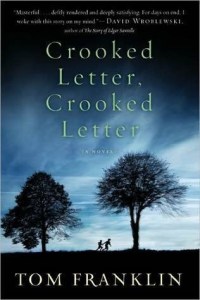 Crooked Letter, Crooked Letter
fiction by Tom Franklin
My rating: 5 out of 5 stars
I don’t read much fiction but, every once in a while, a good novel is exactly what I want. I can usually tell that it’s time by the frustration of not being able to settle on a book. It often has something to do with being tired of grading student essays, which I was by early November. When this happens, I find myself bouncing around among the books in my office, various subjects, then picking up a poetry or story collection, thumbing through, nothing looks good . . . it can go on for days. Then I realize it. No more critical reading, no more grading, no more facts and information. It’s time for a story.
It was that inclination that led me into the stacks of the college library where I work. I had stumbled upon John Irving’s The World According to Garp that way last summer and was hoping to stumble on another equally solid find. As my index finger traced the upright spines in the 813s, Tom Franklin’s name appeared. I had met Franklin and his wife Beth Ann Fennelly in the early 2000s, when they came to the NewSouth Bookstore supporting Poachers (his) and A Different Kind of Hunger (hers). So I chose one of his novels from several on the shelf, at random, knowing nothing about it: Crooked Letter, Crooked Letter. The mystery of its contents was heightened by the fact that, being a library edition, the dust jacket had been removed— thus, no sales pitch, no tantalizing summary.
Published in 2010, Crooked Letter, Crooked Letter is set alternately in the late 1970s and early 1980s and in the 2000s. The story, which occurs in rural southeastern Mississippi, follows two characters whose lives intersect and intertwine through a series of events and circumstances that are beyond their control, and even beyond their knowledge. The first of the two, Larry, is white. His father Carl owns the local auto shop, where he is well-known as a man’s man and a great storyteller, though Larry is quiet and squirrelly, and somewhat creepy as a fan of horror novels. When school integration occurs, Larry ends up zoned for the local black elementary and meets Silas, the other main character, when his father picks up the boy and his mother Alice on the roadside one morning. The black mother and son are standing in the cold, and Larry seems confused about why his father gives them a ride. Ultimately, that confusion becomes tension when Larry tells his mother about their regular passengers, who Carl soon picks up daily, and she puts a stop to it. However, the boys continue to play together in the woods around their houses, until daddy Carl discovers their secret friendship and that Larry has given their .22 rifle to Silas. After their friendship is over, Larry and Silas as they are in each other’s vicinity throughout school. Silas becomes a star baseball player, and Larry becomes “Scary Larry,” the weird one that other teenagers avoid. Their lives eventually converge again when an overly flirtatious white girl named Cindy, who lives near Larry, has a fondness for Silas.
The narrative in Crooked Letter, Crooked Letter is told in a nonlinear fashion, so we get these aspects of the overall story as they relate to what is happening to the two as grown men in their early 40s. Larry has remained in their small town of Chabot, taking over his father’s garage, which now has no customers, and living with his mother until she is moved to a nursing home with Alzheimer’s. Despite living his whole life in his hometown, Larry is ostracized over events that involved Cindy when they were in high school. Silas’s path, however, took him away from the town but brought him back to it. Alice had moved them away after the situation with Cindy, then Silas served in the military before returning to Chabot to become the constable, a job that entailed mostly directing traffic and giving speeding tickets. What restores the connection between Silas and Larry is the disappearance of another local girl, which reignites suspicion about “Scary Larry,” whose name was never cleared.
Tom Franklin does an excellent job in the novel of building a tense narrative within the framework of the small-town South in the late twentieth and early twenty-first centuries. The portions of the story that deal with their boyhood are prime examples of Generation X’s experiences with integration, at school and in the community. The more modern portions address the current quandaries facing small-town Southerners, like diminishing opportunities, inadequate municipal budgets, and the struggles of local businesses. We also have the Faulkner-esque quandary a la Quentin Compson: the past is not dead, it’s not even past. (I won’t go into why I say that, because if I do, I’ll ruin the story for someone who hasn’t read it.)
Last but not least, one thing that I particularly liked was Franklin’s use of kudzu imagery, which I took to be an extended metaphor. Maybe I’m being too much of a literary critic, instead of an ordinary reader, but knowing what I do about kudzu, it’s an excellent metaphor for modern life in the small-town South. Kudzu has no agricultural value but it takes over everything, slowly. It never stops moving and expanding, and it winds itself around anything until what is underneath its tangled vines becomes virtually invisible. This stuff is all over the rural South and can’t be ignored. Throughout the novel, characters were looking out a car window or out across the land at kudzu. It happened too many times to be coincidental. If Franklin did this on purpose, creating visual symbolism, bravo. If he didn’t . . . well, bravo anyway.
