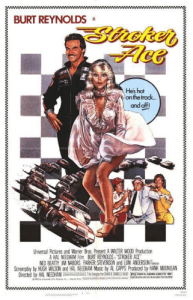
Southern Movie 74: “Stroker Ace” (1983)
The Southern Movies series explores images of the South in modern films as well as how those images affect American perspectives on the region.
The 1983 racing-themed comedy Stroker Ace tells the story of a driver who has allowed himself to be roped into a sponsorship contract that he desperately wants out of. The main character is a fun-loving womanizer who can’t seem to act right, so he keeps losing his sponsors. Unfortunately for him, there is a regional fried chicken chain whose extremely annoying owner wants badly to have a race car with his business’s name on it. Directed by Hal Needham and starring Burt Reynolds in the title role – this was the same winning combo in Smokey and the Bandit – the film also features one of Reynolds’ regular co-stars Ned Beatty (Deliverance, White Lightning) as well as singer-actor Jim Nabors, football great Bubba Smith, and doe-eyed beauty Loni Anderson.
Stroker Ace opens in black-and-white, and we see Stroker and his friend Doc as boys in the rural South. The bicycle they have is messed up because Stroker tried some act of daring on it, and they are stranded by the roadside. Soon, Doc’s dad shows up in a pickup and gives them a ride. But he’s on a moonshine run, and the revenuers spot him! They take off then and speed along a two-lane blacktop before veering onto dirt roads. Stroker keeps taking the rearview mirror fix his hair, but Doc’s dad needs it to keep an eye on the cops behind him. The whole scene is playful, and the action is augmented by the movie’s theme song by Southern rock great Charlie Daniels.
As that scene fades out, a modern one fades in, and we see an adult Stroker Ace fixing his hair in the rearview mirror that same way. He is driving in suburban traffic this time, and soon we see that his mechanic Lugs Harvey (Jim Nabors) is hanging out of the passenger door to counterbalance the weight of the car, which has a front wheel missing. Not to be deterred, he orders Lugs to lean out further so he can make a turn. Meanwhile, the announcer is introducing the drivers who are about to start racing in the Daytona 500. These scene alternates between the raised stage where drivers wave at the gathered crowd and Stroker flying through the parking areas and knocking over pylons. He eventually lands in a spot and jumps out just in time to be introduced. Hamming it up, he smiles for the cameras, ignores the complaint of his angry sponsor, then has the entire stands for no reason before leaving the mic to speak to the good-looking women there. Two of them rebuff his advances because he walked out on them on previous occasions, but the third seems to be a newcomer. We get the feeling that this guy is a mess.
Next, we meet the other characters one by one. Aubrey James is the brash young driver who hates Stroker Ace. James wants to dethrone the great one, the guy who wins most of the time. Mr. Catty is Stroker’s current sponsor – Zenon Oil – and he is aggravated with his driver from the first moment we see him. Next, Clyde Torkle (Ned Beatty) comes bumbling through, smiling and shaking hands with whoever doesn’t escape. Clyde owns a chain of friend chicken restaurants, The Chicken Pit, and he wants a car in the races desperately. Finally, we get a glimpse of a pretty blonde (Loni Anderson), who is standing in the pit looking around when some guys with an air compressor blow her dress up around her neck. She catches Stroker’s eye just before that, but here comes Clyde Torkle to interrupt. With his very large chauffer Arnold (Bubba Smith) in tow, the pudgy little loudmouth accosts Stroker as he tries to go catch up with the blonde mystery woman as she runs off. The chicken man has heard that Stroker is having trouble with his sponsor and wants to step right into that role. Stroker is less than enthused about the idea, but Clyde reminds him that he only ever does one of two things: crash or win.
The race begins, and we see Clyde and Arnold in the press box. Clyde remarks on the 120,000 “fried chicken junkies and God knows who many more watching on the TV,” but Arnold is ignoring him. He then moves across the room and speaks to that blonde woman we saw earlier in the pit. She is his new employee, and he’s ready to leave with her. She doesn’t want to go though, and when he suggests dinner and champagne, she reminds him that she doesn’t drink and that she’s a Sunday school teacher in her spare time. Clyde is thwarted once again. Out on the track, Stroker is thwarted too, by Aubrey James who causes a crash that puts him out of the race.
On the highway afterward, Stroker is driving Lugs and Mr. Catty to the hotel, while the cigar-chomping sponsor fusses and complains. Stroker has wrecked his race car, wrecked his rental car, wrecked his hotel room . . . the sponsor is sick of it. So Stroker plays nice and offers to go in, get their keys, and drive the irate man around to his room. It looks for a moment like Stroker will behave, but instead he arranges for a nearby cement truck to douse the grouchy old man with gray slush while a crowd of bystanders laugh and mock him.
Now, Stroker has no sponsor. But he hasn’t changed a bit. Sitting in the bars with Lugs, he sees that a woman he was with in a previous year, and she is now hanging on Aubrey James, who won the race earlier. When he can’t coax her away with flirty gestures, he feigns an injury by bumping into chair then limping out of the room. She then runs after him sympathetically while Lugs rolls his eyes.
 Back in the pit, now at the Atlanta 500, Clyde Torkle has a car already waiting and a thick contract printed out. Lugs really doesn’t like what he sees happening, but happy-go-lucky Stroker signs the hefty contract . . . without reading it. And that will be the conflict moving forward, which begins right away. When Stroker climbs onto the stage to be introduced, he finds that he is now being referred to as “the fastest chicken in the South.” Chagrined and baffled, he asks why and is told that it’s written on his car! The other drivers and mechanics begin to cluck at him and laugh. Stroker doesn’t like it, but it’s in his contract. Clyde is all smiles now that he has gotten what he wanted. And even better, Stroker wins the race!
Later in the hotel lobby, one of the women that Stroker snubbed in Daytona is looking for his hotel room in Atlanta. Lugs gives her the info and is soon approached by Elvira, Mistress of the Dark, in a cameo. Up in Stroker’s room, that mystery blonde – her name is Pembrook Feeney – is coming there, too. But not for the things that groupies want. She has a marketing plan to discuss with Stroker and finds that he has been occupied. The other woman is leaving, and Stroker was trying to get in the shower. Against her better judgment, Pembrook comes in and gives Stroker a quick overview of the marketing plan that’s he’s a big part of. He isn’t enthusiastic about this, until he finds out that she will be traveling with him.
Their first stop is at a small town store’s opening. Stroker is stretched out the back seat of a convertible while Pembrook drives and Lugs sings in the front seat. They banter a bit, Striker jibing Lugs about his odd style of singing, and the soon the trio arrives. Stroker is expecting to see a huge crowd but only a few people are gathered there. And none seem interested in him. Disgruntled, he gets out and cuts the ribbon while Clyde beams a big smile nearby.
What follows is montage of these kind of appearances: TV, radio, and on-site. The frustration is evident on Stroker’s face, while Lugs and Pembrook put on happy faces. The final insults are a TV commercial that has Stroker in a chicken suit. This is followed by a realization: Stroker can’t get out of the contract, but he can be fired. So in a pre-race gag meant to incite a firing, Pembrook drives him into the race in Talladega on a tractor, sitting a big egg nested in the trailer behind it. Fans boo, and even Clyde knows this one was a bad idea. He looks to be a man who has turned in a hero into a joke. But it doesn’t work. Clyde thanks him instead, leaving Stroker and his friends to try something else. So he is left to drive in a car that he has repainted to look like a plucked chicken. This time, he doesn’t win. The engine blows out mid-race.
Meanwhile, the plot thickens with Pembrook, as Stroker does is best to woo her into submission. He invites her to his hotel room and has champagne, even though she has told him that she doesn’t drink. (He lies to her and says that it is nonalcoholic, ordered special.) However, his plan is thwarted by the arrival of Lugs, who just thought he’d stop by. Sensing that he won’t be getting where he wants to be, Stroker goes out in the hallway to find Aubrey and some other racers playing on rolling carts. Stroker then sneaks up behind Aubrey, gets him moving before he knows who is pushing, then send him through a glass wall into the swimming pool.
The movie now at its halfway mark, about 45 minutes into the 95 minutes total. We move from the rolling cart prank to the hotel bar, where Stroker has a small group of men come to his table to laugh at his chicken-themed racing operation. He takes it pretty well, but soon starts a massive free-for-all brawl by punching a few of the guys. Though Stroker does get knocked around a bit, Lugs has his back, and he even gets to sucker punch Aubrey James.
After that barroom situation, Pembrook goes to see Clyde in his hotel room, to see if he will let Stroker out of his contract. Of course, he says no, then begins to get the picture that Stroker and Pembrook are involved. Not one to read the social cues, Clyde decides that Pembrook must not be as virginal as she claimed, and so in his boxers and stained tank top, he proceeds to see if he can get a little bit of action. Sadly for Clyde, it doesn’t work that way, and he gets kicked in the balls. Pembrook resigns as she stomps, and he replies, Good!
The next morning in the pit, Clyde storms onto the scene with some choice words to say to Stroker. However, he is stopped cold by the sight of Pembrook’s legs sticking out from under the car. He explains vaguely to Stroker that he had to fire her last night, a statement she objects to. Frustrated, the chicken man leaves just as he arrived, reminding Stroker that he may have fired Pembrook but he will never fire him. That evening, the men are going to the opening of a Chicken Pit in separate cars, and Stroker uses some fancy driving to lose them. Arnold ends up putting Clyde’s red Cadillac in the lake right in front of a law enforcement officers’ picnic.
At the event, Stroker is in a little toy car where people can turn him upside by hitting a target with a baseball, like a dunking booth would. Among the people in the small crowd are his old friend Doc and Doc’s father. Once Stroker is done with his obligations, the group sits down to a picnic where they can talk. Doc is now an actor taking on small roles and his father had taken to making jewelry . . . out of pigeon droppings. The scene fades out with Doc singing an old Nat King Cole song . . .
. . . and that’s where we pick up, later that evening, as Stroker and Pembrook are slow-dancing to the real tune. And in that romantic place and time, Pembrook says that she wants to go to bed with Stroker. This is what Stroker has been wanting the whole time! But when he gets to the bedroom where she is, she has passed out. Over the next few minutes we watch as the race car driver hovers over his half-undressed would-be lover, talking to himself in a mental battle over whether he should move forward with it anyway. Ultimately, the good voice wins out, and he leaves her be. The next morning at breakfast, they have a brief talk about it, and Stroker tells her that nothing happened. She is pleased to point of tears, which is how Lugs finds her. He misunderstands the situation then and goes to find Stroker, who stepped away to make a phone call. While he talking to Doc about a plan to get out of his contract, Lugs punches him in the face for the perceived misbehavior.
Next we see, Doc is sitting Clyde Torkle’s office, pretending to be a representative of Miller Brewing. They want to buy The Chicken Pit, Doc claims. Clyde is thrilled but also not sure whether he wants to sell out. Doc shows him a dollar amount and lays out a few stipulations, one of them being that he’ll fire Stroker Ace because of his “questionable reputation.” Clyde, in his awkward way, tries to figure out what to do, and they agree on Sunday for an answer.
As we come to the last race of the season, in Charlotte, all of the conflicts come together. Clyde must decide whether to fire Stroker, and Stroker must beat Aubrey James to shut him up. After a few minutes of scenes from the race site, Clyde appears in the pit to lay out Stroker’s dilemma. If Stroker wins the race, he’ll be too valuable to fire, and they’ll spend two more years together . . . but if he loses, Clyde will sell out and fire his driver. And Clyde even ups the ante by remarking, “What about it, hot shoe? Ever throw a race before?” Even Arnold the chauffeur is offended. Now, Stroker appears to be in a situation where he can either beat Clyde or Aubrey. He has to figure out how to beat them both.
The final twenty minutes of the movie bounce back forth among the varied aspects of the story. Stroker is out on the raceway, and Clyde is up in his press box. Doc has sent his father to pretend to be the messenger who will take his decision back to Miller Brewing. At first, it looks like Stroker will throw the race, and Clyde is left to sit in his box and ponder over whether to give up on his driver and sell. Lugs is disappointed in his old friend, and Pembrook is, too. Yet, the brash young Aubrey changes Stroker’s mind when he pulls up beside and taunts him, claiming to be number one. Stroker then takes off! He will stay in the chicken business. But Aubrey won’t go down so easy. He tries the same trick we saw earlier in the movie, pushing Stroker into the wall to crash. But this time, it fails, and all he succeeds in doing is causing a huge pile-up. Using the clean-up as a way to take a pit stop, Stroker pulls in, but the jack is broken. They can’t change his tires. However, Arnold is nearby, and in one of the movie’s triumphant scenes, the big man lifts the car so they can get their work done.
Finally, 4:00 arrives, and Clyde sees that Stroker is running in sixth place. He takes off his Chicken Pit jacket and hat, then goes over to Doc’s father and says to tell Miller that he will sell to them. Of course, he knows nothing of what’s happening in the pit. Doc’s dad gets the word to Lugs, who tells Stroker to go ahead and win. As that is happening, Clyde goes to the press and tells them that he is firing Stroker. One reporter asks why he would do such a thing when Stroker is gaining on the leader. A confused Clyde has no idea what is happening. Stroker goes ahead and wins the race, scraping his car over the finish line upside down after Aubrey tries his in-the-wall trick one last time. Over in the winner’s circle, Clyde finds out how he has been tricked when Doc and his dad show up. Even Aubrey mouths to Stroker, “You’re number one.” Everything goes right in the end: Clyde gets duped, Stroker wins the race and gets the girl.
Stroker Ace is, for the most part, a good-natured comedy for the dudes. Most of the jokes are either guys giving each other a hard time or guys making veiled sexual overtures toward women. Of course, there are fast cars, too. Whether it’s accurate or not, the movie is a madcap look at the NASCAR scene. Several real drivers, like Harry Gant and the late Dale Earnhardt, appear in scenes. To a working-class, white, male Southern viewer in the 1980s, all of this would have been recognizable, lighthearted, and fun. The story is based on the book Stand on It, about – you guessed it – a race car driver with wild tendencies.
It’s worth noting as well that this movie was one in a string of Southern-centric hits for Burt Reynolds in the 1970s and early ’80s. The list starts with Deliverance in 1972, followed by White Lightning in 1973. Then came WW and the Dixie Dance Kings in 1975 and Gator, which was a sequel to White Lightning, in 1976. Of course, Smokey and the Bandit in 1977. The football movie Semi-Tough, which was filmed in Texas, was also in 1977, and Smokey and the Bandit II came out in 1980. Before this movie, Best Little Whorehouse in Texas was released in 1982. Stroker Ace capped off the stretch.
Yet, not everyone was a fan. The late Roger Ebert opened his 1983 review of the movie with this:
Burt Reynolds used to make movies about people’s lifestyles. Now he seems more interested in making movies that fit in with his own lifestyle. “Stroker Ace” is another in a series of essentially identical movies he has made with director Hal Needham, and although it’s allegedly based on a novel, it’s really based on their previous box-office hits like “Smokey and the Bandit” and “The Cannonball Run.”
To call the movie a lightweight, bubble-headed summer entertainment is not criticism but simply description. This movie is so determined to be inconsequential that it’s actually capable of showing horrible, fiery racing crashes and then implying that nobody got hurt. The plot involves a feud between two NASCAR drivers (played by Reynolds and Parker Stevenson) who specialize in sideswiping each other at 140 m.p.h. in the middle of a race. I don’t think that’s a very slick idea.
His criticisms are fair, but I doubt if Needham and Reynolds were trying to make high art. They were making a movie for the kind of people who liked their movies— big deal! But Ebert’s opinion must have resided among the majority of movie industry folks. Looking at the Film Affinity website, they share four excerpt-blurbs from TV Guide, The Miami Herald, The Washington Post, and The New York Times that all pan the movie and the performances. Once again, I doubt if the film was made for the critics at those publications. Realistically, most of the reviews call Stroker Ace a “good ol’ boy,” which is basically what the character is, and it’s also why a whole bunch of real-life good ol’ boys liked this movie.
