
Southern Movie 79: “Trash Humpers” (2009)
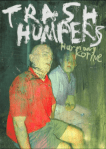
Though he was born in California, director Harmony Korine grew up in Nashville, Tennessee and in New York City. After the success of 1995’s Kids then of 1997’s Gummo, it was in Nashville where he made the bizarre, low-budget Trash Humpers, which was released in 2009. The movie only runs an hour-and-fifteen, and it follows the absurd exploits of an elderly trio who go around the suburbs drinking, destroying things, causing problems, and of course, feigning sex with garbage and other inanimate objects. In its lead-in to a May 2010 interview with Korine, Nashville’s Tennessean called this one “a film that almost defies categorization: an unsettling document of stylized lives lived without regard for narrative structure or decency.” Trash Humpers, which is made in the style of a 1990s VHS home movie, is very weird and possibly pointless, but with Harmony Korine . . . that might just be the point.
Trash Humpers opens with footage of three people, who are either standing in front of a garage door or are humping trash. They are clearly actors in the kinds of clothes that old people would wear, and they have on masks or makeup. (Once we see them moving around, they are clearly not elderly.) We immediately ask ourselves why they are doing what they are doing: dry humping garbage cans and garbage bags on the side of the street, while grunting and groaning. One man attempts sex with a thick wisteria vine on a fence, while another gives a blowjob to hanging tree branch. By the end of this introductory scene, the grotesque tone is set.
Next, the ridiculous antics continue. In daylight, we see the two men in an abandoned house using an axe and a hammer to destroy TVs and knock holes in walls. We assume that the woman is holding the camera as they do this. From there, they are in a parking lot, drinking and sitting around. One of the men lays in the bushes. When night falls, they watch a local soccer game from afar, clean their wheelchair in car wash stall, and then destroy a TV and a boom box in another parking lot. By now, the actors are actually talking, laughing, hooting, and taunting the inert electronics as they kick them and dance around. They finish the scene by throwing cinder blocks from a nearby pile.
Our story – if we want to call it that – moves on. Now, the characters are playing basketball on an outdoor court. Soon, a chubby boy, who is probably eight to ten years old and wearing a black suit and tie, is out there with them, and they laugh at him as he misses baskets. Our view then shifts, and we watch the three half-mumble, half-sing to a baby doll in a clear plastic bag, while the boy stands by. The boy is uncomfortable at all this, but he becomes the strangest of the characters in a moment. Next, they are all sitting in the grass, while the boy explains how to put a child in a plastic bag and shake it. He laughs as he does this. But then it gets worse. From there, he is on a tennis court with a hammer and begins to demonstrate how to he will kill it, beating the doll in the head and body with the hammer. Once again, he laughs while he does this. Even though we know, by this point, that what we are watching is utterly absurd and fictional, it’s still hard to watch a kid smash a baby doll with a hammer while he laughs and proclaims, “I told you I’d kill it!”
Keep in mind: we are only about eleven minutes into this film, which goes on for an hour and fifteen.
Once the boy is through beating the doll, he is sitting in the old woman’s lap in the wheelchair. She is showing him how to put a razor blade in an apple, so the person will not realize it’s there until they’ve swallowed the blade. Nearby, the two old men are passed out on the pavement with empty wine bottles lying next to them. Across the grassy lot, two men run by, and the camera catches them in the background. Yet, they return to action as the boy has one old man pulling him and the woman by a strap around one old man’s neck. The boy again cackles.
That night, the two old men return to humping trash, while the old woman watches nearby. She appears bored and almost asleep. Through the night, they do some humping, which includes tearing off some tall flower stalks and acting like they are jerking them off.
After a few more random scenes of trash humping, we find our three characters back at what appears to be an apartment complex, possibly a nursing home. We are shown two new characters: grown men in surgical gowns with pantyhose stretched between their heads to imply that they are conjoined twins. First, the twins hang in a tree for some unknown reason, while one’s butt is exposed to the camera, then they are in a small apartment making pancakes. They argue over when and how to put the butter on. After a moment, our elderly trio are sitting at a card table in the apartment den clanging their silverware on the plates and demeaning to be served pancakes. The twins bring a stack, but the elderly woman stands up and beginning shouting not to eat them because they’re poisoned. She is cussing up a storm and demands that the conjoined twins sit down and eat the pancakes covered in dishwashing soap instead of syrup. By the time they’re actually eating, the old woman starts ranting about poison, and the twins are encouraged to eat the soap-covered pancakes.
Next, the five bizarre characters are in a basement. Some of the elderly characters appears to be sleeping on the cold floor, while the twins rant nonsensically. For part of this, one of the two is separated, standing on his own without the connection headwear. In the corner, one the elderly characters is humping the side of a refrigerator.
Then, elderly men are in different clothes and are in a bedroom or hotel room with three women, possible prostitutes. Two are white and one is black, and the indiscernible nonsense continues. This appears to be something of an orgy, which ends with the women petting the two men as someone sings “Silent Night.”
 We’re still not at the half-hour mark yet . . . From there, our three characters sit in the home of a middle-aged gay man who tells stories and demonstrates his neck exercises. After that, in the daylight, one of the crew is seen in a Confederate flag t-shirt as he begins humping a large tree, then we spend a minute or so looking at a naked man’s face-down body, lying among rocks and bushes, while someone sings in the background. Once again, we jump inexplicably to the three walking down the railroad tracks, but are then joined by an older man – an actual older man – in a French maid’s costume who is first playing guitar than ranting at them on an overpass bridge. In the next scene, French maid guy is dead in the kitchen with his throat cut.
By this time, we’re at about forty-five minutes with a half-hour left to go. At the risk of minimizing the fact that the absurdity and nonsensical rambling continues unabated, I’ll share a bit about the remaining “plot,” since it’s very difficult to summarize a film like this one. From here, we get a weird birthday party scene where a guy is playing Neil Young-esque guitar licks, another middle-aged man playing trumpet in the bed, yet another older man playing acoustic guitar in his living room, some driving around, some breaking of fluorescent lightbulbs, some bike riding . . . and of course, some trash humping.
The way the film ends is just as disturbing as we’d expect. After intermittently abusing a plastic baby doll throughout the movie, we see the old woman character with a real baby and stroller. She starts inside the house as the baby twists and squirms in her arms, then she takes it outside into the night. The credits appear. Even though we know this has all been staged, we still think, Oh crap, somebody get that baby away from her!
As a document of the South, Trash Humpers gives a glimpse into an otherwise overlooked nook within the larger scope of modern Southern culture: the dark humor of disaffected Generation-Xers who grew up in a generally dull, conservative suburban culture. We all know about William Faulkner and Cat on a Hot Tin Roof and Ernest Gaines, and we all know about the Civil War and the Depression and the Civil Rights movement. When I watch this film, I see a South that I recognize. I see the sense of humor and the weirdly antagonistic playfulness of the skaters, punks, and others who I knew growing up in the 1980s and 1990s in Alabama. As far as we were concerned, there was nothing to do, because nothing around us resembled the vibrant popular culture that we saw on MTV, so we created our “fun” out of what we had. In that vein, I understand how Harmony Korine (who is a year older than I am) and his friends came up with this idea, performed in these bizarre ways, and put it all together in the most undesirable packaging they could imagine. In fact, according to the Trivia section of the movie’s IMDb page:
Harmony Korine had at one point considered leaving the film on unmarked VHS tapes left in random locations to be discovered as a mystery to the unsuspecting public. Korine also considered distributing the film via mailing it to police stations, but this idea was abandoned when such a release strategy would mean the film would not retain copyright.
Some people will watch Trash Humpers and say, “That’s not Southern.” Oh yes, it is! It’s not stereotypically Southern. It’s not canonically Southern. It stands aside from approved features like white-columned mansions, quaint town squares, swarthy demagogues, old black men on porches, and overall-wearing banjo players. Because one aspect of storytelling is eliminating the parts that don’t fit with the larger narrative in the way you want to tell it, some parts do get left out. Today, we call that being “marginalized.” Well, when watching Trash Humpers, we’re looking at “marginalized” Southerners: disruptive, destructive, disaffected white kids who grew up after the twentieth century’s massive social upheavals, bored in the Sunbelt South’s strip malls and suburbs. The GenXers I describe are not the faux elderly characters on the screen— they are the people who thought up these characters to alleviate the boredom of what many considered to be a desirable life. And they’re just as much a part of Southern culture as any guy in a plaid shirt and jeans riding around in a truck and listening to the latest country hits.
