
Reading: “A Real Right to Vote” by Richard Hasen
A Real Right to Vote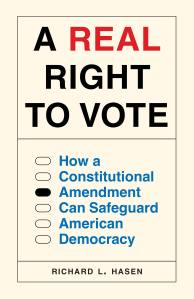
How a Constitutional Amendment Can Safeguard Democracy
by Richard L. Hasen
My rating: 4 out of 5 stars
I first became aware of Richard (Rick) Hasen from watching PBS News Hour, where he is a fairly regular guest. Hasen is a UCLA law professor, who has written several books. This one, published in 2024 by Princeton University Press, makes his argument for a constitutional amendment that establishes the right to vote. It was strange to me, a lay reader, that we don’t already have this . . . but we don’t. Our US Constitution puts elections in the hands of the states, though some laws made by Congress, like the Voting Rights Act of 1965, do lean into the issue by setting parameters. But we don’t actually have a nationally established and inarguable right to vote.
Hasen’s book elaborates his thoughts on why we need one. Among the issues at hand is current tide of litigation that seems to accompany every election, a factor that he attributes to the varying state laws and procedures. Additionally, he provides a well-thought-out array of others factors, such as a voter ID laws, which often discriminate against certain groups. For example, since women often change their name when they get married, while men typically don’t, these laws are more likely to disenfranchise a woman, whose name on an ID may not match her name on a voter list. Likewise for transgender people, whose names or genders may not match between an ID and voter rolls. Beyond those issues, Hasen also points out the ways that members of the armed services can face disenfranchisement in the communities where their bases are located, as well as the ways that physical distance can make the logistical realities of voting harder for indigenous people on reservations.
His solution is to pass a constitutional amendment establishing the right to vote. Of course, within a reasonable framework, this right would enfranchise all eligible and capable citizens, with provisions that would disallow some people from voting: children, the mentally challenged, and non-citizens. Interestingly, in Hasen’s pragmatic view, efforts to pass and enshrine such an amendment would not include protections for felons, a group that loses the right to vote in some states. His rationale seems to be that trying to garner the necessary support for the amendment and take on the felons’ cause too could lead to the failure of the former.
I agree with Richard Hasen’s overall premise that America needs one overarching federal law that protects and guarantees the right to vote for all eligible adults. I also agree that having this one singular amendment could eradicate the need to argue interminably over the constitutionality of myriad state laws. He proposes several times through the book that such an amendment could serve the political goals of both Democrats, who seek to expand voting rights, and Republicans, who seek to eliminate voter fraud. Yet, I support Hasen’s ideas with one major concern. Such an amendment should only enshrine the right to vote and should not tamper with how we vote or how votes are tallied. Recent efforts to “nationalize” elections are frightening as hell to me. So Hasen’s idea that each voter would have a unique federal voting number, kind of like a social security number, really could ensure that no one could vote twice . . . but it could also make it possible for our votes to be affected or altered using that centralized mechanism. It could also enable administrations to know who voted for them and who didn’t.
It’s not a coincidence that the ideas in A Real Right to Vote need attention now. I don’t like the rhetoric that “the right to vote is under assault,” because many millions of us vote in every election cycle unhindered and unhampered. But there are problems and threats at the margins that affect thousands of Americans. I agree with Hasen on two accounts; one, the right to vote should have been enshrined a long time ago, and two, elections can often be decided by a few thousands votes. About the latter point, if an election is decided by a few thousands votes, and a a few thousand people were disenfranchised, then it really does raise the question of whether some elections are legit. The way to resolve it – Hasen and I agree on this – is to stop with the myriad state-level laws and lawsuits about eligibility, and get this one aspect of it enshrined within federal law once and for all.
