
The Watchlist Lives! (The Great Watchlist Purges, Part . . . whatever)
Back in 2020, I took on the idea of emptying out my overfilled IMDb watchlist as a way to keep my mind occupied during the stagnation of the COVID-19 quarantine. And the task did that— it kept my mind occupied searching for and watching the films I had stored there. The main criteria for the watchlist is pretty un-scientific: if I run across a movie that I’d like to watch but either didn’t have the time or the access to watch it, then it gets added. So, if I see something I want to watch and actually watch it right then, it never makes it into the list. But lots of movies do . . . These films span a pretty broad cross-section of subjects, styles, and places, so the watchlist has long had an eclectic quality to it, and delving into it sent me down a rabbit hole. During those awful years of cultural anxiety and collective isolation, I watched a whole bunch of movies . . . and added a whole bunch, too.
As 2023 began, the pandemic had pretty much passed, and I decided that this semi-maniacal pursuit should be finished up. It was time to relax and just enjoy watching movies again. Which is what I’ve been doing since. The good part is that this process reinvigorated my love of movies in a way that I hadn’t enjoyed since the 1990s, in the days of video rental stores. (I’ve watched many more movies than I’ve written about in these purges, but those have been haphazard selections that had nothing to do with emptying the watchlist.) What makes my watchlist particularly difficult is the fact that it is usually stocked with older, obscure, and foreign movies. The good news is that the number of movies out there to watch is endless, and I never get tired of finding them.
Here are the movies in the list that I have found and watched since that supposed “finally final report.”
Born in Flames (1983)
This early ’80s dystopian film about life after a massive revolution lived up to its potential. I had trouble accessing it – I don’t have Apple TV, which offers it – but I found it on archive.org. A story ran on NPR about it more than a year ago, yet it was already on my list, having come up as a suggestion alongside Bill Gunn’s films. But it still wasn’t easy to find . . . The politics here are far-left radical containing strong feminist critiques, including against unions that give preferential treatment to male workers. The radio DJs are spouting off some serious “Damn the man!” rhetoric, and the background music is raw punk rock. The plot centers on an organizer named Adelaide Norris who tries to smuggle guns but gets arrested and dies in custody; Jean Satterfield, who plays Adelaide, is not a good actress, but the unskilled portrayal is really about the politics, not the acting. Personally, I thought the film did an excellent job of presenting the conflicts within the feminist movement, as well as showing how a male-dominated society can downplay women’s issues, even their attempts to defend themselves from sexual assault
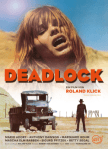 Deadlock (1970)
This German western came up as a suggestion at the same time as the rock n’ roll western Zachariah. Deadlock was very cool, visually and in terms of story. Generally, it was hard to find, too: Apple TV had it at one point, and it was on Mubi’s listings though it wasn’t available. I also found it in archive.org . . . though, of course, now that I’ve seen it, Tubi has it. It appears to be a low-budget movie, but its weirdness derives from the characters who are brought together unwittingly: a young thief in a suit wandering through the desert with a briefcase full of money, an isolated ruffian in loud truck ruling over a ghost town, his aging wife who rants about being a dancer, their strangely pretty daughter who runs around either staring or screaming, a traveling salesman with an overburdened car, the killer who the original thief was supposed to meet up with . . . The premise reminded me of The Good, the Bad, and The Ugly— asking, who will end up with the money that doesn’t rightly belong to any of them? But there’s also a Fellini-esque quality to it. No one can be trusted, and everyone is weird!
Lamb (2021)
I like suspenseful horror films that carry a viewer through the tension to what will happen next. That’s what this one has. Set on a very remote farm, a young husband and wife have no children, then one of their sheep gives birth to a human baby with a sheep’s head. It is clear, though left unsaid that the husband has been “cheating” on his wife with his sheep, and the evidence of this bestiality is now present and undeniable. The remainder of the movie is them living with this child as it grows up. I won’t spoil the ending, but something has to be done about this creature that has no place in the world.
Everything Everywhere All At Once (2022)
I don’t usually watch action films and have little interest in fast-paced Asian action films, which seem be a genre in and of themselves, but this one came highly recommended in the end-of-year news segment about the best films. As an extended metaphor that is carried out through a multilayered daydream, complete with wild subplots and symbolic characters, we see the struggling owner of a laundromat deal with marital problems, business problems, personal problems, tax problems, parenting problems . . . its title is appropriate. This overwhelmed woman takes us on a surreal journey through the fears and anxieties of modern life. Incredible film, just incredible.
Shadow of the Vampire (2000)
Two of the most unique actors around, John Malkovich and Willem Dafoe, star in this story about the filming of 1922’s Nosferatu. In this telling, Max Schreck, who played the vampire, was a really a vampire himself . . . Well, okay, if you say so. On the one hand, the acting was good. On the other hand, the pace was a bit slow in this movie, and the art deco styling got dropped pretty quickly once the crew moved to Orlach’s castle. This was another movie about making movies, and since the figures involved are long gone and not well known, it was hard to latch on.
And here’s the current watchlist as it stands today:
All the Colors of the Dark, or They’re Coming to Get You! (1972)
This movie has been in the watchlist since the beginning. I have memories of seeing this movie in the late 1980s on USA Network’s Saturday Nightmares, but every list that appears on the internet doesn’t include this movie as having been shown on that program. That weird old program turned me on 1960s and ’70s European horror movies, and I could have sworn this one was on that show— but maybe not. But then I can’t imagine where I did see it. No matter, I haven’t seen it in a long time and would like to re-watch it. However, the full movie with English subtitles has been virtually impossible to find, which is strange considering that another Edwidge Fenech’s movies The Strange Vice of Mrs. Wardh is widely available. One streaming service had All the Colors of the Dark but said it was not available in my area, then a YouTuber had shared the original Italian-language movie . . . but I don’t speak Italian, and it has been taken down now. The DVD is also available for purchase from a few sources.
The Adventures of Prince Achmed (1929)
I had never heard of this animated movie before seeing a reference to it on Twitter from an account that was disputing Fantasia‘s designation as the first full-length animated feature film. The clip attached to the tweet was interesting, and I want to see the whole film. It stays in the watchlist.
Personal Problems (1980)
This one is also pretty obscure – complicated African-American lives in the early ’80s – and came up as a suggestion since I liked Ganja and Hess. The script was written by Ishmael Reed – whose From Totems to Hip-Hop anthology I’ve used in my classroom – and the description says “partly improvised,” which means that the characters probably ramble a bit. Other than Ganja and Hess and this film, there is only one other film that Bill Gunn made: Stop!, which was never released. (His other work mainly involves the Man from UNCLE television series.) I still hope to find this movie, maybe it will find its way onto one of the streaming services eventually.
Phantom of the Paradise (1974)
I can’t tell what to make of this movie: Phantom of the Opera but with rock n roll in the mid-’70s? I’ve gathered from the previews that the star is Paul Williams, who later played Little Enos in Smokey and the Bandit, and it looks similar in style to The Rocky Horror Picture Show. This one is not as hard to find, but it’s availability mostly through rentals on streaming services.
Valérie (1969)
Not to be confused with Valerie and Her Week of Wonders, this film is a Quebecois hippie film about a naive girl who comes to the city to get involved in the modern goings-on. This one came up as related to Rabid, but only has 5.1 stars on IMDb— it may be a clunker, we’ll see . . .
The Burning Moon (1992)
What fan of strange horror films could resist this description of a German film made in the 1990s: “A young drug addict reads his little sister two macabre bedtime stories, one about a serial killer on a blind date, the other about a psychotic priest terrorizing his village.” The information on it says that it is really gory, which doesn’t interest me as much as tension and suspense do, but I’d like to see this for the same reason that I wanted to see House before.
The Conformist (1970)
I like Bertolucci but am not really into movies about Nazis, so I had ignored this movie previously. Then it came up in a show about movies that referenced Nazi movies like The Damned, and the critics they interviewed kept saying that this is a great movie. I gave the overly long 1900 a chance, so I’ll probably do the same with this one.
After Sun (2022)
This was also one of the movies suggested as one of that year’s best in a December 2022 PBS NewsHour segment. After Sun tells the story of a woman looking back at her father and trying to reconcile the man she knew with aspects of his life that didn’t know about.
Richard III (1955)
This movie came up as a suggestion after I watched Richard Burton in a late-1960s adaptation of Marlowe’s Doctor Faustus. This mid-1950s adaptation of one of Shakespeare’s histories was produced by, directed by, and stars Sir Laurence Olivier. Sir John Gielgud and Ralph Richardson co-star. (As a GenXer, my main association for the latter actor was his role as the old wizard-teacher in Dragonslayer.) I like Shakespeare’s plays but I have to be in the mood for them. Between working in theater when I was younger and teaching twelfth-grade English for years, I’ve read, taught, watched, or worked more than a dozen of his thirty-seven plays. This is one that I don’t know well.
A New Leaf (1971)
Walter Matthau stars in this comedy about a young guy from wealthy family who has blown through his inheritance. He is lazy and has no employable skills. His solution is to find a rich wife within six weeks . . . then kill her. This appears to be one of those quirky films that popular actors have, which fall between their memorable performances. In this case, A New Leaf came out between The Odd Couple and The Taking of Pelham One Two Three. I always think of Matthau as Buttermaker in The Bad New Bears, which is funny because in 1971, he was playing a bachelor looking for a wife . . . then five years later, he was playing a washed-up drunk.
Loving Couples (1964)
This Swedish film’s description says that it has three pregnant women recalling their sex lives. It’s a strange premise. The only Swedish films I can recall seeing are both classics from the late 1950s: Wild Strawberries and The Seventh Seal. Those are both by Ingmar Bergman, and this one is by a female director named Mai Zetterling, who I’m not familiar with. The fact of a film with that premise being directed by a woman also makes it interesting to consider.
Heartaches (1981)
I’m not sure what to think about this one, but I’d like to find it and see. Margot Kidder and Annie Potts star. The description says that it’s about a young married woman who is pregnant with another man’s child, so she takes off and hits the road. Then it says that she meets a “free-spirited” friend, and they become the odd couple. The whole thing sounds very 1980s, but it also seems to mix the common story elements of adult stories (marital dysfunction) in the ’80s and teenage stories (meeting a wacky new friend while on an adventure) in the ’80s.
The Hired Hand (1971)
A western from the early 1970s that stars Peter Fonda— there is no way I could pass that up.
La Notte (1961)
Jeanne Moreau and Marcello Mastroianni star in this early 1960s Italian film about an “unfaithful married couple.” It is highly rated on IMDb, and the first of several reviews is titled “cruel, dark, and harsh.” This should be a good movie, but probably heavy too. I will add that this director Michelangelo Antonioni also made Blowup (1966), which centered on a hip, young British photographer. I didn’t like Blowup, because its main character was not likable and there was virtually no plot. A decade later, he made The Passenger (1975), and I only watched the first twenty minutes or so of that film and turned it off, because it also seemed to have no plot . . . We’ll see if this one passes the smell test.
Dog Star Man (1964)
Not sure what this movie will be. I’ve never seen anything by this director Stan Brakhage, who is an American. The description says it’s a “experimental film [ . . . ] in which a man and his dog ascend a wooded mountain.” The title caught my eye because of the novel The Dog Star, but that’s about a closeted gay teenager in New Orleans, so this story isn’t related. We’ll see . . . It is available on YouTube, so I’ll watch this some time soon.
Chelsea Girls (1966), Blue Movie (1969), and Cleopatra (1970)
Anyone familiar with Andy Warhol’s work knows that his interest in the mundane can often lead to some real boring “art.” But he also made those wild adaptations of Dracula and Frankenstein that had Joe Delassandro in them. So Warhol kind of weaves back and forth between two different kinds of “What am I watching . . . ?” All of three these were made by Warhol, and some (or all) may not be worth watching. But it’s Andy Warhol, so I’ll roll the dice and watch any or all them if I find them.
Stroker Ace (1983)
This is another one of my throwbacks, one to rewatch. As a GenXer who grew up in the Deep South in the 1980s, movies like Smokey and the Bandit, Six Pack, and this one seemed like the coolest things we’d ever seen. Unfortunately, many of those quirky Southern comedies are harder to find now and are generally regarded as cult classics.
Watership Down (1978)
Watership Down was a commonly assigned novel when I was growing up, but if I read it, I don’t remember it. This animated adaptation was made in the late 1970s, a few years after the novel was published in 1972. Of course, the story is an allegory since the characters are rabbits, but in the era of climate change, the tale may be particularly relevant.
Seven Beauties (1975)
I added this film after the multi-part documentary Women Make Film: A New Road Movie through Cinema noted that this one marked the first time a female director was ever nominated for an Academy Award for Best Director for Lina Wertmuller.
Noises Off . . . (1992)
I’m not a guy who enjoys musicals generally, but my older brother suggested to me that this film adaptation of the classic stage play is particularly good. He’s a long-time theater guy, so I trust his judgment enough to spend two hours watching a movie I might not otherwise choose. Peter Bogdanovich directs, and Michael Caine and Carol Burnett star.
Kaos (1984)
A collection of shorts based on Luigi Pirandello stories— what?! I used to teach Six Characters and Right You Are, If You Think You Are in my creative writing classes. Based on those plays and on the fact that it is titled Chaos, I’d bet these stories are wonderfully and aggravatingly confusing!
The “A Ghost Story for Christmas” episode of Lost Hearts (1973), I Start Counting (1970), Rawhead Rex (1986), Penda’s Fen (1974), The Company of Wolves (1984), and Dust Devil (1992)
All of these came my way through Woodlands Darks and Days Bewitched, a three-hour documentary on the folk horror subgenre made in 2021. Some of the movies they discussed were American, but many were European and Japanese. Lots of them looked like they could be good, but who knows which ones might be available here. I’ve already watched Dark Waters, which came up in a search soon after I added these to the list. Also, I recognized a couple of them, like Leptirica, so there’s always hope.
Alice in Wonderland (1976)
I had this movie in the watchlist at one point before, out of my affinity for Hy Pyke, and I ran across it again while searching for the 1988 eastern-European Alice that I just watched recently. It sounds like this movie could be a soft core porn film, or it could just add sexual overtones to the story— given the quirkiness of the 1970s and the oddball cast, I’d like to see what they did with the story here.
The Twilight People (1972)
This movie looks very Dr. Moreau-ish. The rating on IMDb is only 4.1 but I’ve disagreed with those ratings many times, so I’m going to give this one a chance. It’s by a Filipino filmmaker, and Pam Grier plays one of the half-human, half-animal characters. Should be interesting.
May Morning (1970)
Watching films about hip young people in the US versus watching films about hip young people in Europe shows how different the two youth countercultures were. This film is an Italian-made thriller about students at Oxford University. Generally, I like Italian movies from the 1960s and ’70s. The description is also compelling: “A dramatic and penetrating examination of the intellectual and moral standards existing at England’s Oxford University . . .”
Tennessee Nights (1989)
I ran across this film when I was looking for a documentary about Tennessee that I couldn’t remember the name of. The description says that a British lawyer doing some work in the South gets framed for a murder he didn’t commit, and somehow that conflict involves an interracial relationship with a black woman. It stars Julian Sands, the British actor who disappeared from a hike last year then was found dead, and Stacey Dash, who played the best friend in Clueless. IMDb has it with a low 5.4 rating, but the cast is strong: Ned Beatty, Rod Steiger, Johnny Cash.
And below are the movies that have entered and left the watchlist in the year since the “finally final report” . . .
High-Ballin’ (1978)
A cheesy action-comedy about two truckers whose operation is being taken over by shady characters using dirty tactics against drivers out of the road. It stars two of my favorites – Peter Fonda and Jerry Reed – but this one is a real clunker. It’s trite and predictable, and the efforts at throwing in some of the late-1970s quirky stuff are random and weird. Calling this a “period piece” or a “goofball comedy” would be kind.
Kid Blue (1973)
It’s hard to go wrong with Dennis Hopper. It’s even harder when it’s a western that co-stars Warren Oates and Peter Boyle. This is one of the dying-of-the-West movies, where the people whose identities were built upon the Wild West had to find other ways of living once civilization started taking root. I wouldn’t go so far as lumping it into the “existential western” subgenre, with films like The Shooting, but it has elements of that.
92 in the Shade (1973)
I really wanted this movie to be good, because the novel is. I also wanted it to be good, because of the cast: Peter Fonda, Warren Oates, Margot Kidder, Burgess Meredith. But it wasn’t good. The emotional complexity of the story was lost in this film. Reduced to little more than the plot, the depth is gone. And as with so many literary adaptations, fragments of story elements are there but the context and backstory for them are gone, cut for the sake of time. Some novels are better left alone, and this story would have better left to the printed page.
The Pleasure of Being Robbed (2008)
I wanted to like this indie film, too, but its blasé, apathetic tone was too similar to other millennial-made films that I haven’t liked. The story, which has little in the way of plot, centers on kleptomania, and its main character is generally uninteresting. She just kind of bounces from scene to scene, with stealing as the common thread. One reviewer on IMDb said the he/she didn’t understand why people dislike the film, then proceeded to name the reasons (as positives) that I disliked the film. The info there also says that it began as a concept for a purse commercial, and it probably should have remained that, because there was no story to develop.
The Fog (1980)
Adrienne Barbeau plays a radio DJ in the Pacific Northwest whose station is located in a cliffside lighthouse. She tries to warn everyone about this killer fog that creeps in, but people don’t want to listen. This one also falls into the creepy-Pacific-Northwest-seaside subgenre, alongside movies like Humanoids from the Deep. Cheesy ’80s horror movies aren’t scary, but they are awesome.
Häxan (1922)
This early silent film, made over one hundred years ago in Sweden and Denmark, was in my watchlist for a while, but I cut it after being unable to find it. Then I found it. Using fairly crude cinematography, we see a history of witchcraft and paganism, including what Hell might be like, with Satan and all of the creep devils and other ugly creatures. The dim lighting, screenshots of old European art, and cheap animation make it particularly spooky!
Lolly Madonna XXX (1973)
I noticed this movie at first because of its strange title, and it ended up being quite good . . . until the end. There are two feuding families in Appalachia, and to lure one away from their still, members of the other family send a phony love letter to a young man in their rival family. It is all a ruse, but it becomes true when a random young woman, who is passing through and doesn’t know any of this, gets off at the bus stop at the time the letter said that the phony woman would arrive. Rod Steiger plays the overbearing head of one family, and Jeff Bridges is one of the brothers, probably the most enlightened in the group. The movie is excellent, the plot is solid, the acting is excellent, and the premise is unique—but the end falls flat. After two shootouts between the families, it just kind of stops . . . and the credits roll. Wonderful movie, shitty ending.
Doctor Faustus (1967)
Richard Burton plays the mythic scientist who makes a deal with the devil, and Elizabeth Taylor plays an ephemeral spirit that is alternately tantalizing and tormenting. It doesn’t stick exactly to the play though. A couple of lines prompted me to go back to Marlowe’s play, and nope, they weren’t there. But for a late-1960s adaptation, this one still gets high marks. Richard Burton’s classical style stands the test of time, and I particularly liked the sullen, foreboding seriousness of the bald actor who played Mephistopheles.
The Mule (2018)
Clint Eastwood has made great grouchy-old-man movies in his latter years, starting with Gran Torino. In The Mule, Eastwood plays a retired orchid grower whose dire financial situation creates the willingness to become a drug smuggler. Of course, he is basically solitary, somewhat agreeable, and generally non-threatening, so he gets away with it for a long time. And of course, the family he neglected for years hates him now. But this is still a good movie, even for those aspects that are kind of expected.
Crossing Delancey (1988)
If you like things that are very 1980s, Jewish, and set in New York City, Crossing Delancey is for you. It’s got all the things: overbearing relatives, unsuitable suitors, an independent bookstore, no action at all. But don’t take that to mean that it isn’t a good movie. It is. Of course, Amy Irving’s wide-brimmed brown hat is an iconic ’80s image, and if you watch the whole film, you’ll get to know why.
The Last Picture Show (1971)
This movie is so lonely, and it is also one of those remarkable films where the setting is an integral and predominant feature in the story. In this wind-swept town, the barrenness and emptiness set a tone for the events. The cast is also excellent: Timothy Bottoms, Jeff Bridges, and Cybil Shepherd as three young people in a love triangle in a dying small town. This is just a damn good movie.
Mr. Majestyk (1974)
He just wants to bring in his melons. Why won’t people let him?
She Beast (1966)
I wanted this movie to be good . . . Barbara Steele is so unique-looking with those big eyes that she makes for good imagery on a poster or in a still. But the movie itself is weak. The story is based on the killing of a nasty-looking old witch, who comes back and inhabits the body of Steele’s character. As horror movies go, it’s a solid premise, but also one that’s been used. In the mid-1960s, this might have been interesting or scary, but watching it fifty-plus years later, not so much.
Exorcist III (1990)
I had forgotten how weird and dialogue-heavy this movie is. It is more than thirty years old now, and unfortunately, this third Exorcist movie is showing its age. George C. Scott and Brad Dourif are very good actors, and each does his part: Scott as the hardboiled cop who was friends with Damien Karras, and Dourif as the man who is now possessed. I think the director was trying to recreate the vibe of the original, which was also dialogue-heavy, but it was much more effective in the first film.
Phantasm (1979)
This classic horror film is so GenX. We’ve got the kid who is alone because his parents died, we’ve got the cool older brother who drives a muscle car, we’ve got gratuitous shots of women’s breasts during a make-out session in a graveyard— c’mon! The movie also has elements of the plot that are totally random: a best friend who is a guitar-playing ice cream man, a blind fortuneteller with a pretty granddaughter who speaks for her, a black maid who comes out of nowhere in one scene, evil midgets in hooded robes who make weird noises, a discovery about the true nature of evil during a random visit to an antique shop. Phantasm is a mixture of creepy, weird, random, and fun.
I See You (2019)
We all get a bit startled when we hear a noise in the house, a bump or something that doesn’t seem right. But this story takes that to the extreme. Told out of chronological order, this suspense/thriller has a story you definitely don’t see coming. I won’t spoil it, but when the unrelated plot lines converge, the tension is ultra-high. I can’t remember this movie being a big deal when it came out, but it is really good.
Remember My Name (1978)
This lady is creepiest ex-wife of all time ever. I couldn’t have imagined what this movie was going to be about, and it is slow-developing. But once I realized that the lady who was lurking around Anthony Perkins’s character was his ex-wife . . . it’s like Fatal Attraction but decades earlier, less violent, and with a different twist. (No pets get killed in this one.) She just wanted to show up and mess up his current relationship . . . by wandering into his house and stuff like that.
Querelle (1982)
This is the gayest movie I have ever seen! Based on a novel by Jean Genet, the story centers on a sailor who is initiated into homosexual sex by a brothel proprietor who makes his customers gamble with dice to know whether they’ll get to have sex with a female prostitute or get bent over by him. The movie stars Brad Davis. It is lit with a yellow glow, the setting is tropical, the scenery is theatrical, and many of the actors are wearing white sailor suits. So gay . . . so, so gay.
Casa de Lobo (The Wolf House) (2018)
This animated movie is captivating and creative and unique and wonderful, then when you finish it, you think, “What the hell did I just watch?” The basic story follows a girl who is hiding from wolves, which are metaphorical of course, but it’s the flowing claymation visuals that make this film worth watching. Everything is in motion the whole time, with sets and characters morphing constantly. Really, really cool movie.
Black Christmas (1974)
It would be too easy to call this movie formulaic, because it was one of the movies that created the formula. I hadn’t realized until I was watching that it stars Olivia Hussey, who played Juliet in Zeffirelli’s Romeo & Juliet. Now that we have caller ID and cell phones and now that college campuses have security cameras everywhere, the premise of the story is less viable. But in the days before we knew who was on the phone, the caller-killer’s weird giggling and moaning and the fact that he was climbing in through the attic would have made audiences’ skin crawl. Additional fun act: director Bob Clark, who made this movie, also made A Christmas Story and Porky’s. What a resume!
Times Square (1980)
This lesser-known movie takes on a few classic elements to create something GenX out of them, like the odd couple who come together under tough circumstances. After two teenage girls escape from a mental ward, they relocate to an abandoned warehouse and dub themselves the Sleez Sisters. They go around mixing with the street people, throwing TVs off of buildings, and working in a low-end strip club. Three things about this film: the period soundtrack is great, some of the dialogue is very un-PC, and the unrealized young lesbian sexual tension is palpable. Times Square puts the classic GenX twist on the coming-of-age story— the cool kid seems fun and interesting until you figure out that she really is unstable.
Bones and All (2022)
On one level, this film about cannibals reminded me of Let the Right One In, but on another, it’s a road movie and a love story that’s also a stalker film. Because of their tendencies, the cannibals have to lay low, lead quiet and unassuming lives, and move around a lot to avoid suspicion. The gory parts of the movie are really bloody, but the tension is quite well done. The young female main character is basically trying to figure out who she really is and how she can live her life, which kind of makes the film an allegory for it means to be different or a nonconformist.
Walk on the Wild Side (1962)
We have to feel sorry for the main character in this movie. An old black-and-white from the early 1960s, the story follows a highly moralistic Texan who is left behind by the woman he loves, so he throws caution to the wind and goes looking for her. Unfortunate for him, he encounters another woman on the road who is rotten to the core, and when he finds his love in New Orleans, she is working in a whorehouse. Then, the woman he met and rejected on the road starts working there, too. And man, everything from there on works against our hero. He gets double-crossed and run off and beat up. His only chance for salvation is that a woman who owns a roadside gas station/hotel/restaurant takes him in (and falls in love with him) but he even messes that up. The phrase “a fool for love” comes to mind.
Joe (1970)
If the 1970s had had cancel culture, Peter Boyle would have been on the bad list for this film. The story’s conflict centers a young hippie girl, played by Susan Sarandon. She is dating a artist/drug dealer who is mean and abusive. Her upper middle-class father goes to gather her things at their apartment after she ODs in little grocery store, and he encounters the druggie boyfriend, fights him, and kills him. Then he meets Peter Boyle’s character Joe in a downtown bar where he goes to cool off. Joe is like Archie Bunker if the show had been on cable TV. This one is intense, with lots of un-PC sentiments expressed, as well as some serious social commentary that makes stark comparisons between working-class and middle-class disdain for the counterculture, liberals, and people of color. These two square conformists who wanted to “Make American Great Again” more than fifty years ago show us that they definitely are not the good guys. I won’t completely spoil the ending, but the rich dad does find his daughter after she runs away, and it doesn’t go well.
Short Eyes (1977)
I didn’t know it before watching this movie, which is based on a stage play, but the term “short eyes” was (is?) prison slang for a child molester. The term is odd enough that this movie caught my attention with its title. The central character, who is the catalyst for the plot but not the main character, is played by Bruce Davison, who I knew from Willard and from the screen adaptation of The Strawberry Statement. This time, he plays a guy who is wrongly accused of molesting a little girl and is thrown into a cell block that already has severe racial divisions and other tensions in it. In the cell block, white men are sorely outnumbered by groups of black and Hispanic men, and even the guards hate Davison’s guts for his alleged acts. Another side plot involves a young man who several other inmates have set their sights on as a potential sexual victim, but he is resistant to their advances. This brutal story is swimming in racial, social, and sexual tension. One bright spot in the otherwise dark story comes when the men put their differences aside for something like a sing-along, which is led by Curtis Mayfield, who plays one of the convicts.
Katie Says Goodbye (2016)
Very bleak. It’s hard to watch a young woman, who seems very sweet, to lead such a shit life. Her mom is lazy and spends the money she earns, she sleeps with a middle-aged trucker for extra cash, she dates an ex-con who barely speaks. I can’t say that I blame her— I’d want to say goodbye, too. But the acting is good, and the scenario draws our sympathy. Good movie overall, just bleak.
The Blow-Up (1966)
This movie was awful. David Hemmings, who I recognized from Deep Red, plays an art/fashion photographer in England, and the character is a huge asshole. He spends most of the movie driving around really fast and treating people like they don’t matter. A young Vanessa Graves also stars but by the time she gets involved in what is happening, I was so over the main character that I had trouble getting anything from the latter portions when a story actually emerges. The short version is that he accidentally takes a picture of something he shouldn’t have, but he even did that while being asked not to.
Hard Country (1981)
This modern cowboy film stars Jan-Michael Vincent playing a young working dude in Texas and Kim Basinger as his girlfriend who wants to move to California to become a stewardess rather than stay where they are. It’s kind of a cheap knockoff of Urban Cowboy, which came out the year before. The best friend is played by Tanya Tucker who is – you guessed it – an up-and-coming country singer, and a pre-Splash Daryl Hannah plays her fifteen-year-old sister. Kyle’s co-worker and best friend is a portly knucklehead played by Gailard Sartain, who GenXers would recognize as the teacher who would have let those kids burn in The Outsiders. This is more of a slice-of-life movie than anything else.
Tollbooth (1994)
This mid-’90s clunker set in south Florida stars Fairuza Balk as a quirky gas station attendant who is obsessed with the father who left when she was a child. Now grown up, she has convinced her mild-mannered boyfriend, who wants to be a vice cop in Miami – like the TV show – to get a job in a tollbooth, while she works in a gas station, because her long-lost father, who was a cab driver, will certainly either pass through or gas up. Mixed in are a middle-aged bait shop owner who the young woman is having sex with, a tollbooth co-worker who is operating a money laundering scam, and a depressed mom who insists that the husband who abandoned them will return. There’s also some weird symbolism using butterflies, and a very good and quite eclectic soundtrack.
Priest (1994)
I forget how I came across this movie, but it’s a British and runs on PBS in the United States. The Catholic priest at the center of the story is closeted gay man, and his fellow priest at this poor, urban parish is a leftist radical who is essentially common-law married to their black housekeeper. The politics of the film are interesting, as the two priests debate the Church’s treatment of the urban poor, and there is also a side plot about a local girl who is being molested by her father. The priests’ handling of the issues they face bring the doctrine of the Church down to ground level, using working-class and leftist rhetoric to call societal and Church norms into question. One other thing: the gay sex scenes in this movie are kind of graphic.
187 (1997)
This violent but surprising high school film stars Samuel L. Jackson as a science teacher who gets stabbed multiple times by a disgruntled student (played by Method Man). A year later, he is living in California and returns to teaching via a substitute gig in a rough LA high school. Of course, he butts heads with some guys in a gang, but tries nonetheless to save the students that he can. This movie suffers from the major flaw that most ’80s and ’90s high school films have: he seems to only teach one class, instead of five or six. There is also the standard fare of apathetic co-workers and hopelessly bureaucratic administrators, but they are offset by another often-seen character: the pretty female teacher who actually cares. This mostly formulaic movie gets kind of twisted in a way, since his answers to the commonly seen problems are not predictable. As a hint, his last showdown with the bad guys harkens back to a famous scene from The Deer Hunter.
White Sister (1972)
Interesting film this one. Sophia Loren plays a nun who is a hospital administrator, and her nemesis is a lazy communist party representative who resides in the hospital to keep an eye on things. She insists that, because he was injured once but isn’t anymore, he should leave the hospital. His response is that he is working and can’t do his job if he has to leave. Most of the other patients seem to like him, and he uses that to incite a strike among the employees. There is sexual tension between the two, in addition to a larger set of conflicts that occur in the hospital: a plaintive diva in traction, a workers strike, etc.
Keoma (1976)
As spaghetti westerns go, this one was weird as shit. Here’s the description: “A half-breed ex-Union gunfighter attempts to protect his plague-ridden hometown from being overridden by his racist half-brothers and a Confederate tyrant.” The title character was taken in by a family with three sons, and he is the redheaded stepchild. The father loves him and cares for him, but his half-brothers don’t. He grows up to become this wild-man drifter and eventually has to have a showdown with his brothers. One of the supporting characters is a black man who was once a strong and kind role model to the “half-breed” in the past, but now he is a demoralized itinerant musician with no dignity. There’s crucifixion scene, and multiple times you’ll think the conflict is over, but then it isn’t. Like many westerns, this is a one-against-many story, but it is not cut-and-dried in any way.
Dark Waters (1993)
Each decade’s horror movies have their vibes. 1970s horror films have a feel, 1980s horror movies have a feel, 1990s horror movies have a feel. This one is very 1990s. The premise is that a young woman has traveled from England to a remote Italian island, where there is a convent and no modern technology. Her father, who has recently died, was wealthy and was sending regular monetary donations to the convent to support it. She has come to ask why, in order to discern whether she should keep sending the money. In the process, she finds out the horrible truth about the isolated convent and about her own past: a demon is imprisoned underneath it, and she is one of its two daughters! All throughout we’ve got weird music and random crying and groaning sounds. And of course, the nice nun who was helping her turns out to be her monstrous sister!
Cisco Pike (1971)
Kris Kristofferson, Karen Black, and Gene Hackman star in an early ’70s movie about guy who is forced by a cop (Hackman’s character) to sell a large quantity of pot in a weekend. Though I’m a big fan of late 1960s and early 1970s counterculture movies, I had not seen anything about this one until very recently. It has a lot of the marks of a period piece, and there’s a slice-of-life quality to it. But there’s also a story: Kristofferson’s character is a former teen idol whose success has not translated into an adult career, and Hackman does a good job playing a super-uptight and very square cop. The drama of the narrative is that everyone sees Cisco Pike as a failed star turned drug dealer, and he wants back into music business. Not a bad movie, just not great.
Alice (1988)
Made in central Europe in the late 1980s, this movie is billed it as a “surrealistic revision” of Alice in Wonderland, and it came up as a suggestion after I liked Casa de Lobo. In the opening scenes, the little Alice character says that it’s kind of made for children, but also kind of not. That’s a good description, too. Though it does follow Lewis Carroll’s iconic story, some elements are altered, and the tone is generally pretty dark and weird. Though I enjoyed it, I can see a child being creeped out by it. For example, the rabbit is stuffed with sawdust, which he eats to re-stuff himself, and he keeps his watch inside of belly instead of in his pocket. Later in the movie, when there are animals with skulls for their heads and a frog in an 17th-century wig with a really creepy tongue. And as with so many surrealistic films . . . did the main character dream it, or was it real? We end with Alice brandishing a large pair of shears, wondering to herself if she should cut off the rabbit’s head for being late.
Jigsaw (1968)
I put this movie in the watchlist because I saw Michael J. Pollard featured prominently on the poster. Pollard was one of a kind. The character actor, who died in 2019, usually played a nerdy or otherwise un-self-confident kind of guy, someone easily pushed aside. I particularly liked him in Little Fauss and Big Halsey, but he was also good in Bonnie & Clyde. But in this one Pollard’s character, who is a hippie drug dealer involved in a kidnapping scheme, has barely a role in the film. The movie itself OK, not great, a little long-winded with too much dialogue. It tells a strange story about a covert military plan to use acid to manipulate a very straight-laced think-tank guy whose job is to figure out what might happen in a nuclear war. Nonetheless, I wanted to see more of Michael J. Pollard, but ended up watching a couple of 1960s squares in suits and ties as they tried to figure out who was dosing them and why.
I had also been keeping an eye out for these fourteen movies that I had previously cut from the watchlist in 2021 and 2022. Of the original eighteen, I actually found and watched four. But most of them remained in the discard pile.
The Panic in Needle Park and Dusty and Sweets McGee were both from the 1971 and are about hardcore drug users. I generally liked movies from the early 1970s, but didn’t put much effort into finding these two after watching Born to Win, which was not a good movie. The Panic in Needle Park has Al Pacino in it, so it might actually be pretty good.
The inclusion of Mountain Cry (2015) was kind of a fluke. It came up when I searched the term ‘haiku’ on IMDb once. It appears to be a beautifully filmed Chinese drama about a family in a small village, but getting an American version doesn’t seem possible.
Two by director Carlos Mayolo, The Vampires of Poverty (1978) and La mansion du Araucaima (1986)— both look intriguing. Vampires of Poverty is fictional but made to look a documentary about the poor. The latter is about an actress who wanders off a film set and into a weird castle. I did find an original Portuguese-language version of the latter online, but that didn’t help me much.
The title of 1985’s Alabama lured me in— because it’s not about Alabama, the state where I live. The film is Polish, and one of the posters says “love story” on it, so I’m guessing that it’s a love story. I was mainly curious why it’s titled Alabama, but I’ll probably never find out.
The Night They Robbed Big Bertha’s (1975) has been hard to find, but from the previews, it looks awful. This one made it into the list because, along with Smokey and the Good Time Outlaws, it seems like a great example of 1970s Southern kitsch, that goofy comedy sub-genre that spawned Smokey and the Bandit and The Dukes of Hazzard.
The Girl Behind the White Picket Fence (2013) was one that I found in a search for Udo Kier, who I’ve liked since seeing Andy Warhol’s versions of Frankenstein and Dracula when I was in high school. The cinematic style of this one looks pretty cool, as does the story. Unfortunately, the only way that to get his film is by buying it.
Endless Poetry (2016) was actually in my Netflix DVD queue when they stopped sending movies them. Alejandro Jodorowsky is hit-or-miss for me. I liked The Holy Mountain and Santa Sangre but not El Topo. This movie about him is supposed to be done in his strange style.
Three that were disappointing not to find were: Beginner’s Luck (2001), Tykho Moon (1996), and White Star (1983). The first two star Julia Delpy, who was one of my 1990s celebrity crushes after I saw Killing Zoe and Before Sunrise. (The other was Hope Sandoval, singer for Mazzy Star.) These movies look very different from each other, and Delpy is the common element. This third is a biopic, directed by Roland Klick, and it has Dennis Hopper playing Westbrook, the rock journalist.
Last but not least, there is The Earth Will Swallow You (2002). How has a guy who loves Widespread Panic never seen this early concert film? Ridiculous. It’s partially my fault, since you can buy a DVD on Amazon for under $20. However, clips are easy to find, but not the whole thing. I think I’ll just be satisfied with the clips.
