“Ode to Billy Joe,” 50 Years Later
Today, June 4, 2026, marks the fiftieth anniversary of the release of the 1976 film Ode to Billy Joe. The original concept came from the Bobbie Gentry song of the same title.
The lyrics and style of the original song are haunting. The fingerpicked guitar and the sultry sound of Bobbie Gentry’s voice might remind a modern listener of Dolly Parton’s “Jolene,” but this time there’s a jazzy swagger to set the tone instead of a desperation in a lovelorn request. (“Jolene” came out six years after this song, in 1973.) In “Ode to Billy Joe,” released in the summer of 1967, Bobbie Gentry is singing about a conversation at the family table. It is summer in the Mississippi Delta, and they are discussing mundane matters, and also the suicide of a local boy named Billy Joe McAllister, who jumped off a bridge. The speaker in the song is a teenage girl, and her involvement in whatever caused him to jump is implied. The girl loses her appetite after her brother mentions that he saw her talking to Billy Joe after church on the Sunday prior. Near the end of the song, her mother says that the preacher stopped by their house and had told her that he had a seen Billy Joe and a “girl that looked a lot like you” throwing something off the same bridge that Billy Joe jumped from. We don’t know what has happened between Billy Joe and the girl, but it sounds ugly.
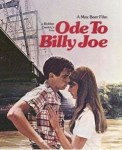 The 1976 adaptation, released fifty years ago today, was directed by Max Baer, Jr., who was probably best known to fans of classic television as Jethro Bodine on The Beverly Hillbillies. This was Baer’s third (and final) foray into making feature films, after 1974’s Macon County Line and 1975’s The Wild McCullochs. The first of those, Macon County Line, was one he wrote and starred in, but did not direct. The film was surrounded by a minor controversy that was rooted in the opening credits stating it was based on real events . . . when it wasn’t. Beyond that, the film lacked a coherent plot line then devolved into a strange kind of random violence. Looking at reviews and ratings, that second film, The Wild McCullochs, was just bad. Baer directed that one, then he directed Billy Joe.
The problem with adapting this popular song into a feature film is that the song’s appeal lies in its mystery. We never know what Billy Joe and the girl were seen throwing off the bridge, so we assume that it was something they wanted to remain hidden. It is implied that the female voice telling us the story was that girl and she implies that she knows what happened but doesn’t tell. So we never do know why Billy Joe jumped or why she mourns him. However, in a film, it becomes necessary to show us what happened, since film is a visual medium, and generally audiences want some kind of resolution to a conflict. To make this song into a film, Max Baer, Jr. needed to alter the original narrative, eliminating the mystery and giving audiences some relief in the form of an answer.
For reasons I will never understand, Baer chose to replace that mysterious quality with the element of guilt after an illicit homosexual experience. Where did that come from? The song never says one word about a Billy Joe having a homosexual experience, never even implies it. My best interpretation of the song is that our speaker had gotten pregnant by Billy Joe, then hid the pregnancy and delivered the baby in secret, which was what they threw off the bridge. That interpretation has flaws, but I can’t think of a better one in the poor farming culture of 1950s rural Mississippi. They certainly weren’t tossing bags of cash from a bank robbery or sacks of bloody clothes from a killing spree (which are some things that a modern director might try). The film ignores the thing thrown off the bridge and shifts the plot and conflict to Billy Joe’s guilt over a sexual encounter with another man, which occurs in shadows of the seedy adult section of the local fair reserved for a batch of prostitutes that had been brought in.
What was, in some ways, even harder to deal with, for me, was who this homosexual experience was with. The other person involved in the tryst was the local sawmill owner Dewey Barksdale, played by James Best. As a GenXer who was a boy during the heyday of The Dukes of Hazzard, James Best was well-known as Roscoe P. Coltrane. the buffoonish sheriff who tried and failed to do Boss Hogg’s bidding again and again. I know that Dukes of Hazzard ran from 1979 to 1983, and that Ode to Billy Joe was released in 1976, but I couldn’t watch it – well after its release and well after the TV show had ended – without connecting Best to that silly and clownish TV character. I also couldn’t help asking myself about the movie, If they really did bring in a bunch of prostitutes to the local party, what young man would snuggle up to James Best instead of one of those girls? If Billy Joe did that, then he did have some personal issues that would have been hard to reconcile with the culture he lived in.
By this time, fifty years after the film’s release, Ode to Billy Joe is not that big of a deal. But it is interesting to me as an example of an early Southern movie that dealt with the issue of intolerance toward LGBTQ people in the culture. Billy Joe is so distraught about what he has done that he cannot go on with life. Toward the end of the film, after Billy Joe is dead, Dewey approaches the young girl who is left behind, Bobbie Lee Hartley, and offers to out himself as the cause of Billy Joe’s death. She tells him that it won’t matter and leaves him to deal with his guilt on his own. Considering Ode to Billy Joe, which is set in the 1950s, in light of films with LGBTQ themes that preceded it, like 1959’s Suddenly, Last Summer and 1961’s The Children’s Hour, it’s a pretty dour assessment of the reality on the ground at the time.

I enjoyed your take on this Foster. I never saw the movie but remember the song well. I was 28 years old in 1976 and some crazy things were going on in my life. Hope all is well with you and Vicki. Pete Peterson.
LikeLike
Thanks, Pete! I hope y’all are doing well, too.
LikeLike